




10.06.2026
Sustainable Logistics Equipment: Fewer Replacements, Lower Costs
24.06.2026
By BOA Concept Group · June 2026 · 5 min reading
In most automation projects, the actual TCO significantly exceeds the initial budget. Premature wear and tear, hard-to-source parts, and the replacement of entire sub-assemblies: the hidden costs of poorly designed equipment quietly pile up. What our 2025 CSR report reveals is that a rigorous environmental approach delivers a measurable impact on the economic performance of your lines.
The hidden cost of logistics equipment that is never factored into the initial purchase price
When investing in a conveyor line or an automated sorting system, decisions are most often based on the purchase price and the return on investment (ROI) timeline. However, other factors deserve specific attention.
The operational reality of an automated warehouse includes unplanned downtime, spare parts that are impossible to source five years after installation, and sub-assemblies replaced as a whole because they cannot be repaired individually. These costs—corrective maintenance, lost productivity, premature equipment replacement—rarely appear in sales proposals. Instead, they hit operating balance sheets, sometimes as early as the third year.
This is precisely where the sustainable design of an equipment becomes a compelling financial argument.
Sustainability and Industrial Performance: A False Divide
For a long time, integrating environmental requirements into the design of industrial equipment seemed incompatible with performance and cost imperatives. This is not an absurd position; it reflects real trade-offs and compromises that sometimes existed in the past. However, industry practices have evolved.
Designing a conveyor with 95% recyclable metal by weight is no longer an enforced constraint. It is proof that the equipment is made from a premium, homogeneous material that is easy to work with, simple to replace segment by segment, and highly valuable at the end of its lifecycle. The modularity dictated by environmental specifications is the exact same modularity that allows a technician to replace a faulty component in two hours rather than ordering a complete sub-assembly with a six-week lead time.
This is no coincidence. It is a design philosophy that benefits both the environment and the operator. This logic begins right on the production floor. Our conveyor equipment is manufactured in Saint-Étienne, which is a meaningful choice. Local manufacturing means a short supply chain, a reduced transport footprint from the very start, and, above all, total control from design through assembly. It is difficult to guarantee 98% recyclability on equipment when you do not control how it is made.
WHAT OUR 2025 FIGURES ILLUSTRATE
In our third CSR report, the environmental characteristics of our equipment directly reflect design choices that impact their useful lifespan:
▪️98% overall recyclability — standardized, easily sourceable materials that can be replaced individually
▪️100 % reusable components — standardized, easily sourceable materials that can be replaced individually
▪️95 % recyclable metal by weight — homogeneous materials, simplified maintenance
▪️17 % integrated recycled metal — consolidated supply chains, reducing vulnerability to supply shortages
CSR and Supplier Selection: The Rising Criterion in RFPs
Supply chain departments are no longer the sole decision-makers when choosing an equipment manufacturer. Procurement departments, CFOs, and CSR managers are increasingly involved in automation investment decisions, particularly within corporate groups subject to non-financial reporting obligations (CSRD) or those committed to carbon reduction pathways.
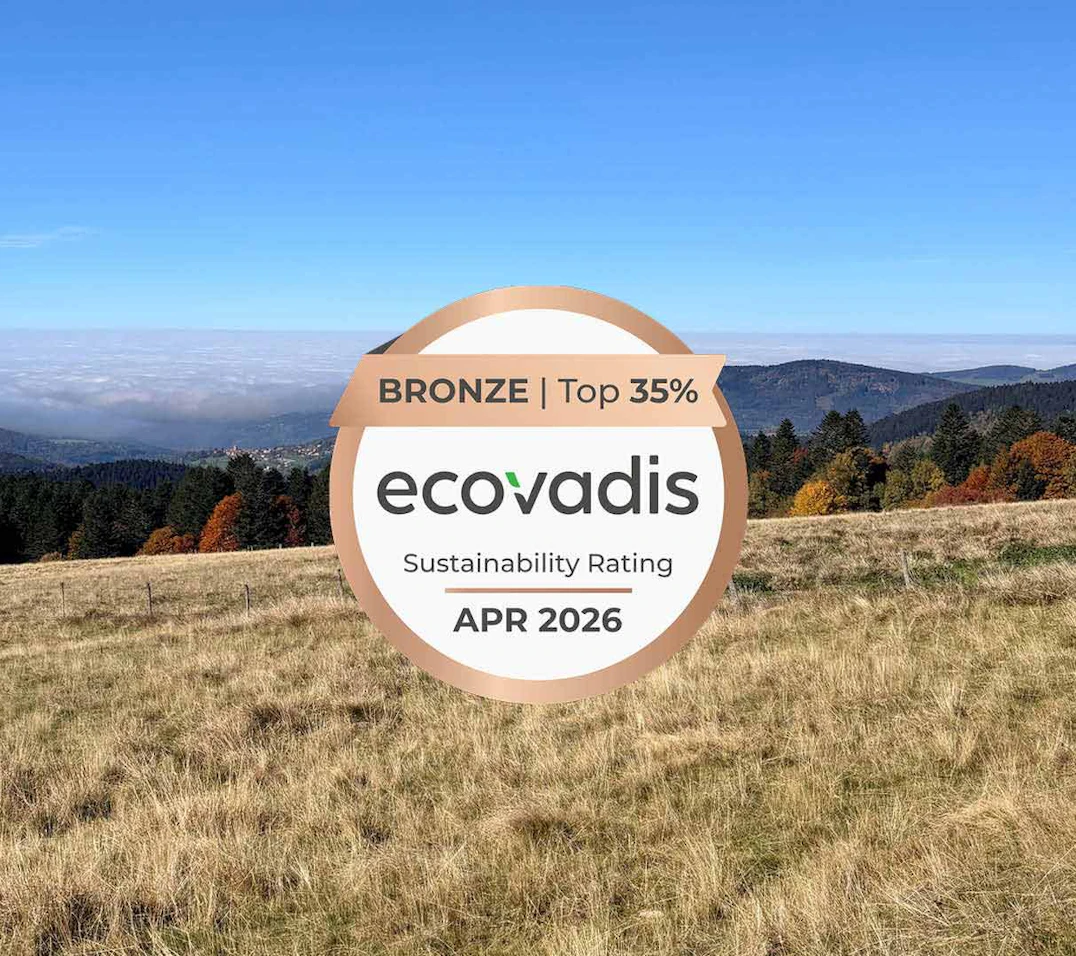
In this context, a supplier's ability to document its environmental practices is no longer just a bonus. It has become a prerequisite for joining certain vendor lists. The EcoVadis Bronze Medal we achieved in 2025, which places the BOA Concept Group in the top 35% of assessed companies worldwide, directly addresses this requirement: it provides our clients with third-party, standardized, and comparable proof.

What distinguishes a credible CSR approach is continuity and measurability. With the publication of our third annual report, we are documenting tangible progress.
On the environmental front, our key indicators now include a rigorous monitoring of emissions per employee and per thousand euros of revenue. Our partnership with Elise, a corporate recycling specialist, has enabled us to structure our sorting systems and recycle 397 kg of waste in 2025. Our target to reduce relative GHG emissions by 17% by 2027 is fully integrated into our strategic plan.
On the social front, our local anchoring has resulted in 23 formalized partnerships with local players throughout the Saint-Étienne region—the very same territory where our equipment is manufactured. This is no coincidence: an industrial company that manufactures locally and invests in its human ecosystem builds a form of resilience that balance sheets do not always capture.
"Corporate social responsibility is no longer a side project, but a lever for transforming our model. Our goal: industrial solutions that are increasingly high-performing, sustainable, and responsible."
— Jean-Lucien Rascle, CEO of BOA Concept Group
The concrete impact on an automation project
If you are managing a warehouse automation project, here are the right questions to ask your equipment manufacturers:
▪️ What is the recyclability rate of the proposed equipment, and what does that mean for maintainability? ▪️ Are the components individually replaceable, or do complete sub-assemblies need to be replaced in the event of a failure? ▪️ Is the supplier able to provide a third-party CSR assessment (such as EcoVadis) that can be used in your own procurement reporting? ▪️ What is the guaranteed availability period for spare parts after installation?
FAQ
What is the Total Cost of Ownership (TCO) of logistics equipment?
TCO includes the initial purchase price, preventive and corrective maintenance costs, unplanned production downtime, the cost of spare parts, and the residual value at the end of its lifecycle. Modular and repairable equipment significantly reduces maintenance and replacement costs over 10 to 15 years of operation
How does equipment recyclability impact its maintainability?
Equipment designed with homogeneous and standardized materials (recyclable metal, standardized components) is mechanically easier to repair component by component. The modularity required by environmental standards facilitates the targeted replacement of faulty parts without having to dismantle the entire line.
What is EcoVadis certification, and why is it relevant when choosing an equipment manufacturer?
EcoVadis is the world's leading business CSR assessment platform (with over 130,000 companies evaluated). It provides a standardized rating covering the environment, labor & human rights, ethics, and sustainable procurement. For a procurement or supply chain director, it allows for the objective comparison of suppliers based on CSR criteria and feeds directly into their own CSRD reporting.
News