





22.10.2026
E-commerce: 5 Signs Your Logistics Are Holding You Back
22.10.2026

By Pauline Jurado · October 2026 · 5 min read
Logistics has long taken a back seat to other strategic priorities. As long as orders ship on time and customers aren’t complaining, it goes unnoticed. But as volumes grow, ambitions expand and customer expectations rise, it can shift from a competitive advantage to a major bottleneck.
How can you tell if this is already happening in your organisation? Here are five warning signs to watch for, along with practical steps to regain control.
Warning Sign 1 | Is Your Logistics Operation Holding Back Your Growth?
Logistics holds back growth when operational teams spend their energy firefighting instead of contributing to projects that add value.
Last-minute resource reallocations, clearing backlogs, resolving carrier disputes: when these tasks take up most of the available time, they point to a structural capacity problem. The organisation is running in circles rather than moving forward. Optimisation projects, new offerings and expansion into new markets consistently take a back seat to the latest urgent issue.
The question is straightforward: is your logistics operation still equipped to support your ambitions, or is it consuming a disproportionate share of your organisation’s time and resources?
📌 Key takeaway:
A well-functioning logistics operation frees up your teams. An overloaded one ties them up. If your organisation spends more time managing crises than driving performance, the warning sign is clear.
Metric to track: Time spent firefighting versus time spent on optimisation and operational innovation.
Warning Sign 2 | Why Do Demand Peaks Expose Weaknesses in Your Logistics Operation?
Demand peaks expose logistics weaknesses because they eliminate the spare capacity that masks operational issues under normal conditions.
Black Friday, seasonal sales, Mother’s Day: these events are predictable. Yet for many e-commerce businesses, they still provide a harsh reality check. During peak periods, buffer stocks run low, teams are stretched to capacity, equipment runs at full output, and even the smallest disruption immediately affects the customer experience.
A resilient logistics operation should absorb significant fluctuations in volume without a noticeable decline in service quality. When every peak leads to missed delivery deadlines or an overwhelmed customer service team, it signals that staffing or equipment flexibility is falling short.
📌 Key takeaway:
Demand peaks don’t create logistics problems; they expose them. If every peak period triggers a crisis, your logistics setup needs to evolve beyond simply adding temporary staff.
Metrics to track: Order picking error rate and average time to dispatch during peak periods versus normal operating periods.

Warning Sign 3 | What Is the “Cost of Poor Quality” in E-commerce Logistics?
The cost of poor quality in e-commerce logistics covers all expenses and indirect losses caused by operational failures, including refunds, customer service enquiries, returns and damage to your online reputation.
These costs are rarely consolidated into a single dashboard, making them difficult to quantify and easy to underestimate. An overloaded operation inevitably triggers a chain of problems: longer lead times, higher return rates and a surge in customer enquiries. Customer reviews and post-delivery ratings can also damage your reputation, with lasting effects that are difficult to reverse.
📌 Key takeaway:
The true cost of underperforming logistics goes far beyond visible operating costs. Refunds, customer service costs, negative reviews and lost repeat customers: combining these costs into a single metric often highlights the need for investment.
Metrics to track: Delivery service level, return rate, volume of logistics-related customer service enquiries and average post-delivery customer rating.

Warning Sign 4 | Why Is a Lack of Real-Time Visibility a Logistics Risk?
A lack of real-time visibility creates logistics risks because it prevents teams from anticipating stockouts, delays customer updates and slows operational decision-making.
With customers tracking their parcels minute by minute and warehouse teams managing flows order by order, organisations relying on disconnected systems face a structural competitive disadvantage. Real-time visibility into inventory, order status, and inbound and outbound flows is no longer a benefit reserved for large enterprises: it is essential to the agility of the entire organisation.
Connecting e-commerce tools with warehouse systems through robust APIs is now fundamental to transparent, responsive logistics. Discover how our BOA Central Suite warehouse control and monitoring software supports this approach.
📌 Key takeaway:
Connected logistics goes beyond parcel tracking. It enables you to anticipate stockouts, proactively update customers and manage flows in real time. Without this connectivity, every decision comes too late.
Metrics to track: Average time to update order statuses, proportion of customer enquiries related to order tracking and frequency of unexpected stockouts.
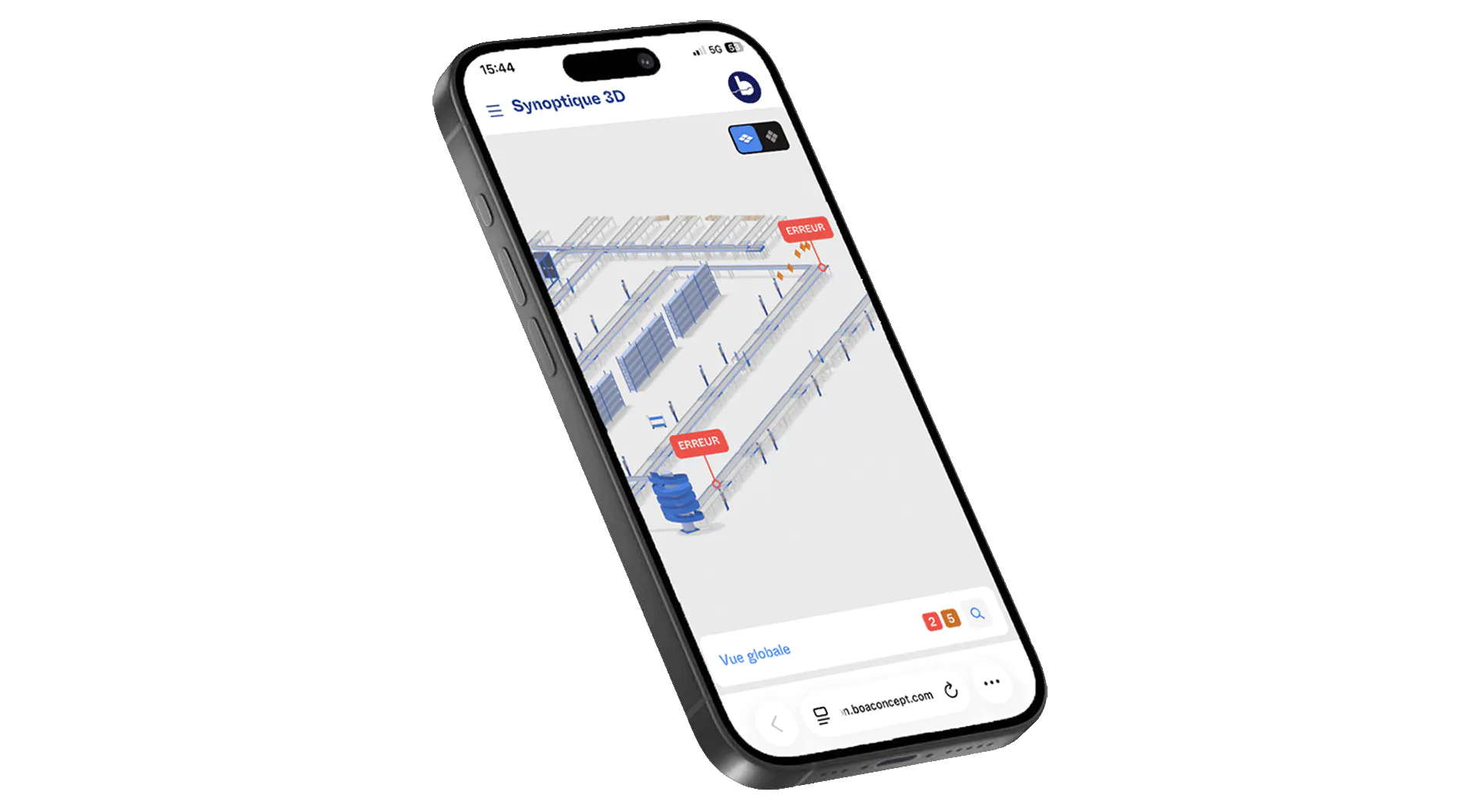 BOA Central Suite mobile app
Warning Sign 5 | When Does Logistics Start Holding Back Your Commercial Strategy?
Logistics holds back your commercial strategy when expansion into new markets, channels or product ranges is constrained or even blocked by the limitations of your existing infrastructure.
This is the most strategic warning sign, yet often the least visible in day-to-day operations. It emerges when difficult decisions have to be made: entry into a new market is postponed because of insufficient dispatch capacity, a new product range is put on hold because the warehouse cannot accommodate it, or a partnership is delayed because systems are incompatible. When logistics regularly appears among the constraints shaping strategic decisions, it has stopped supporting growth and started limiting it.
A modular, scalable logistics operation should allow you to integrate new flows without a complete overhaul every time your business evolves.
📌 Key takeaway:
Logistics should support your strategy, not dictate it. When commercial decisions are consistently constrained by operational limitations, your infrastructure needs greater flexibility, not necessarily more space.
Metrics to track: Average time to integrate a new flow or market, and proportion of strategic decisions constrained by logistics limitations.
How Should You Respond to These Warning Signs? A Structured, Step-by-Step Approach
The recommended approach involves three steps: audit your existing flows, identify the priority area, then test on a small scale before rolling out more widely.
Recognising these warning signs is the first step. Addressing them does not necessarily require a complete overhaul. For organisations looking to move forward without taking excessive operational risks, a phased approach—outsourcing a specific flow, automating a particular workstation or deploying modular equipment in a limited area—allows teams to test the approach, learn and manage change internally before a full rollout.
The aim is not change for its own sake. It is to ensure that logistics remains what it should be: a driver of performance, not a limiting factor.
📌 Key takeaway:
There is no one-size-fits-all solution. The right approach depends on each organisation’s specific needs. But one principle holds true: it is better to make gradual, controlled improvements than to wait for a crisis before taking action.
News